Fiscal year 2021-2025 facts
73
New awards
funded
34 M
Award
obligation
87
PI and co-PI
on awards

Program overview
The National Science Foundation (NSF) plays a key role in advancing fundamental research across science and engineering disciplines through funding both individual and collaborative research efforts, as well as supporting facilities, equipment and educational programs that contribute to workforce development. Established in 1950, NSF funds approximately 24% of all federally supported basic research conducted at U.S. colleges and universities. For comprehensive guidance on proposal preparation and submission, applicants should consult the NSF Proposal and Award Policies and Procedures Guide (PAPPG), which outlines key policies, submission requirements and award administration procedures.
- BIO: Life sciences and biological research.
- CISE: Computing, communication, and information technologies.
- ENG: Engineering research and education for innovation and quality of life.
- GEO: Earth, ocean, and atmospheric sciences.
- MPS: Math, physics, chemistry, astronomy, and materials science.
- SBE: Human behavior, economics, and social systems.
- EDU: STEM education and workforce development.
- TIP: Use inspired translation research and workforce development.
- OISE: Promotes the U.S research community's access to international knowledge, infrastructure and capabilities.
- OIA: Advances interdisciplinary science and engineering for societal benefit.
Process of NSF application
Applying for NSF funding is a multi-step process that requires careful preparation and early action. The NSF Roadmap outlines five crucial stages.
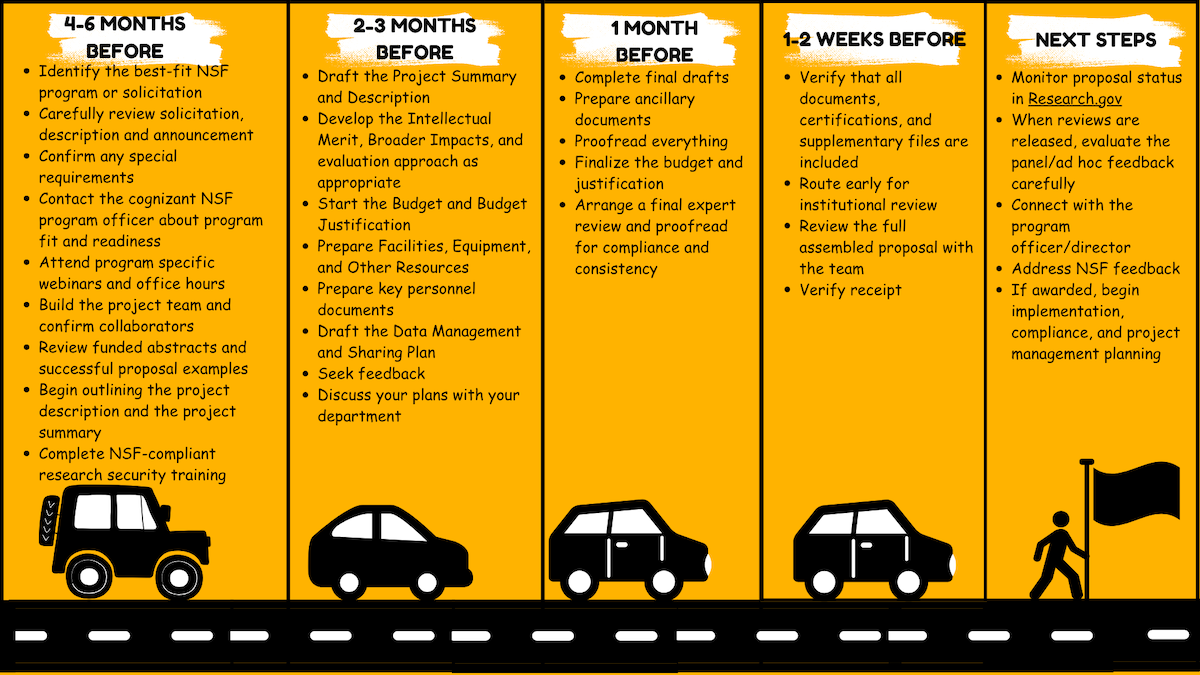
Resource table
To support faculty and researchers in securing NSF funding, the research development office offers a range of resources.
| Resources | Details | Resource type |
|---|---|---|
| Grant Academy | A training program that helps faculty work with experts to develop strong proposals and successfully apply for NSF funding | Professional development program |
| Proposal library | Provides investigators with examples of successfully funded research grants from VCU faculty. The library includes a broad range of research topics from various funding agencies. | Digital library |
| Data management | Document detailing how data will be managed and shared. | Online toolkit |
| SciENcv | A guide explaining how to use SciENcv in myNCBI to create the 2024 Common Forms (Biosketch and Current, Pending, and Other Support reports) for NSF and National Institutes of Health (NIH) in their new formats. | Online guide |
| Collaboration tools | A tool designed to aid in the identification of experts, collaborators and partners for your NSF proposals. | Research support |
| Proposal writing guides | Utilize proposal writing guides for NSF applications or request research development support from our team. | Online guide |
| NSF award database | Provides details on all current and previous NSF grants. Users can perform searches using various criteria and also explore information organized by program type. | Database |
| NSF proposal checklist | Provides guidance on preparing proposals for NSF grants, emphasizing the importance of following specific solicitation guidelines, which may differ from standard requirements. It highlights the need to review relevant chapters (II.D for Research proposals and II.F for other types) to ensure compliance, as non-compliant proposals will be rejected or returned without review. | Guidance document |
| Explore VCU Research (EVR) | For discovery of VCU’s expertise and scholarly output | Discovery platform |
Broader impacts
The broader impacts of a research project are those components that, beyond the advancement of knowledge, have the potential to benefit society and contribute to achievement of specific desired societal outcomes. The NSF requires proposals to address the broader impacts in addition to the intellectual merit of the project. You can learn more on our broader impacts page.
Funding opportunities
Funding opportunities are provided through the NSF website, where researchers can find information on funding mechanisms, eligibility criteria and application guidelines. Additional information regarding specific program requirements can be obtained by contacting the relevant NSF program office. Key proposal deadlines and target dates are regularly updated on the NSF website and within individual funding opportunity announcements. Researchers should also refer to the websites of relevant NSF Divisions and Offices for program-specific deadlines and updates.
Faculty can use the embedded Pivot search tool to find funding opportunities.
(May need to wait a few seconds to load)
Frequently asked questions
Proposals that do not comply with NSF guidelines will be rejected or returned without review. To ensure compliance with sponsor requirements, please collaborate with your departmental and central research administrators, allowing sufficient time for thorough review.
Broader impacts are a key component of NSF proposals, demonstrating how the research will benefit society. Use tools like the ARIS Broader Impacts Toolkit to develop strong broader impact statements.
Generally, NSF aims to inform applicants within 6 months of proposal submission. However, this can vary by program. You can track your proposal status through Research.gov after submission.
Common reasons for proposals being returned without review include missing or incorrectly formatted biosketches, incomplete current and pending support forms, exceeding page limits, and omitting required sections. Always use the NSF proposal preparation checklist before submission to ensure compliance.
To prevent delays or rejection, pay close attention to these frequently overlooked details:
- Missing “Results from Prior Support” for all PIs/Co-PIs: NSF requires that each individual listed on the cover sheet as a PI or co-PI include a “Results from Prior NSF Support” section in the proposal, if applicable. Omitting this information for even one person can result in the proposal being returned without review.
-
Improperly formatted letters of collaboration: Letters of collaboration must strictly follow NSF formatting guidelines. Submissions that include informal or incorrectly structured letters may be returned. In some cases, corrections may be allowed if caught early, but this is not guaranteed. To avoid delays or rejections, ensure all letters meet current PAPPG formatting and content requirements.
-
Being over budget: Exceeding budget limit may result in rejection or return of proposal for revision or justification.
- Not adhering to solicitation specific requirements: Each NSF solicitation has detailed instructions and not following them can lead to administrative rejection before peer review. NSF treats their requirements as mandatory and not optional.
- Omitting required sections: This can result in automatic rejection or return without review or delays if NSF allows resubmission or correction. These sections are critical because reviewers rely on them to evaluate the proposal's significance and impact.
-
Including documents not allowed can violate NSF submission rules resulting in rejection of proposals
To find the right NSF program officer or contact for your specific research or proposal, visit https://www.nsf.gov/awards/who-to-contact.
Contact us

Mary Strawderman
Research development administrator
Division of Research Development
